Genuine vs. Dyed or Heat-Treated Crystals: A Spotter's Guide
Learn to spot dye pooling, unnatural saturation, and coated surfaces with simple at-home checks, and read...

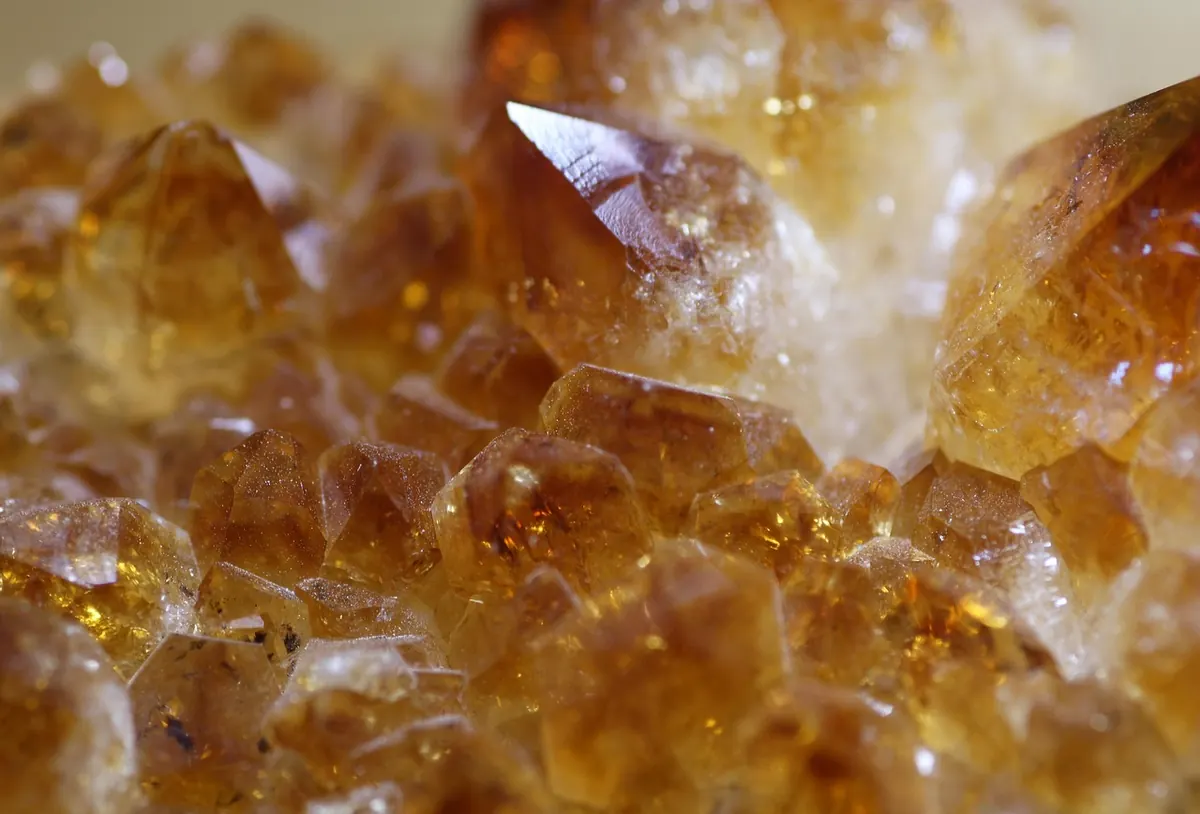
Hold a quartz point against a lamp and the stone stops being a simple window. A drift of green flecks, a spray of gold needles, a cloudy shadow shaped like the crystal's own tip — those marks are inclusions, material trapped while the quartz grew. They are the closest thing a stone has to a birth certificate, and learning to read them changes how you buy.
An inclusion is any material sealed inside a crystal during growth, or a cavity left by it. Three families matter in quartz. Solid inclusions are the visible ones: needles of rutile, flakes of hematite, films of chlorite. Fluid inclusions are microscopic pockets of water, brine or gas, sometimes with a bubble that shifts when you tilt the stone. Negative crystals are cavities that mirror the host's form, as though a small piece had been taken out of the inside.
Not everything inside is an inclusion. Fractures, scratches and coatings belong to a later chapter of the stone's life and are read differently. Nor does a clean interior prove quality by itself: flawless natural quartz exists but is uncommon, and synthetic quartz is grown clean by design. A large, perfectly clear stone at a modest price deserves a question — ask where it came from.
Rutile is titanium dioxide, and in quartz it usually appears as thin metallic needles with a gold to copper color. What separates good rutilated quartz from a random scattering is orientation. The needles follow the host's crystallographic directions, so in cross-section you often see three sets meeting at roughly 60 and 120 degrees, like a fine hexagonal net. Dense webs of short needles are called sagenite; long straight needles in a water-clear body are what most buyers picture.
Judge a piece on three things: the clarity of the quartz between the needles, their distribution, and their condition. A cluster in one corner leaves the rest of the stone empty, and material so densely needled that it turns opaque loses the sparkle that made it attractive. Brazil and Madagascar supply much of the market, with Pakistan and Australia adding distinct material. Faceting rutilated quartz is delicate work — a needle reaching the surface can chip during polishing, and one lying just under a facet can read as a scratch in photographs.
Chlorite is a soft green sheet silicate, and it behaves quite differently. Rather than forming needles after the quartz crystallized, it settles onto a crystal face when growth stalls — a change in fluid chemistry, pressure or temperature — and the quartz then grows over it. The result is a phantom: a green outline of an earlier, smaller crystal suspended inside the finished one. Some specimens hold a stack of them, each layer recording another pause.
Color runs from pale sage to near-black forest green, and fine chlorite dust can tint a whole stone. Because the phantom boundary is a physical discontinuity, these stones part more easily along those planes, and cutters often orient the phantom parallel to the table instead of letting it cross a facet edge. Sharp, well-defined phantoms are what collectors watch for; a green smear with no recognizable shape is just cloudy quartz with a story attached.
Once rutile and chlorite are familiar, the rest of the vocabulary comes quickly.
Inclusions record chemistry and timing. Rutile in quartz is a cooling feature: titanium that entered the lattice at high temperature becomes insoluble as the crystal cools and exsolves along the directions the structure permits. That is why the needles are straight, parallel and obedient rather than random. Chlorite phantoms record pulses — a crystal that stopped, was dusted with clay minerals, then started again. Fluid inclusions preserve a sample of the solution the quartz grew from, and geologists read their salinity and phase state to estimate temperature and pressure.
For a buyer, that diagnostic value is practical. Inclusions that obey crystal symmetry, sit wholly inside the stone and come with growth zoning usually point to slow natural growth. Bubbles lined up in a crack, a flash of color inside a fracture, or sticky residue along a surface-reaching fissure can mean cracks were filled with resin to improve apparent clarity — a treatment that should be disclosed and that needs gentler cleaning.
Two markets look at the same stone and see different things. The faceting trade wants clarity, and a rutile needle under the table is a visible flaw that can also weaken the piece. The specimen and jewelry trade wants character, and a well-arranged spray of gold in clear quartz is what makes a stone worth setting. Neither view is wrong; know which one you are buying into.
Even distribution, strong contrast and a clear body lift a stone. Rutilated quartz with needles spread through limpid material is a different object from one with a cloudy base and a few hairs near the tip. Defined phantoms, a moving enhydro bubble, a crisp sagenite web or a hematite firework also raise a piece above the ordinary. Large stones with clean bodies and well-oriented inclusions are scarce, and the price reflects it.
Dense inclusions cut transparency and make polishing risky. Needles and phantom planes are weak lines; a stone can chip along them, and heavily included quartz more often arrives with a nick at the girdle. Needle-bearing slabs are fragile, and ultrasonic or steam cleaning is unkind to fractured and filled material — lukewarm water, a soft brush and a quick dry are safer.
You do not need a laboratory. Decent light, a dark surface and a little patience will do.
Keep inclusions in perspective, too. They are geology, not medicine; claims about health effects sit outside what the crystal records. What the inclusions do tell you, reliably, is how the quartz grew, where it paused and what was in the water around it. That is a good story to own — and a better reason to buy than a flawless surface alone.
Photo: Dieter444 / Pixabay
Learn to spot dye pooling, unnatural saturation, and coated surfaces with simple at-home checks, and read...
A practical guide to Italian mineral fairs: how the shows are organised, how pricing and etiquette work,...
A simple spring equinox routine for sorting, sunning, airing and recharging your crystal collection, with...